China’s Globalisation vs America’s Policing

12.00am, 12th March 2021
Soham Aher, Senior Correspondent
China’s Globalisation vs America’s Policing
While the United States is now the world's largest economy, the International Monetary Fund predicts that China will overtake it in purchasing power parity in 2025. Globalization has benefitted China greatly. It has spent decades improving its skills and establishing business relationships with a variety of countries. It has established itself as a significant international partner and investor.
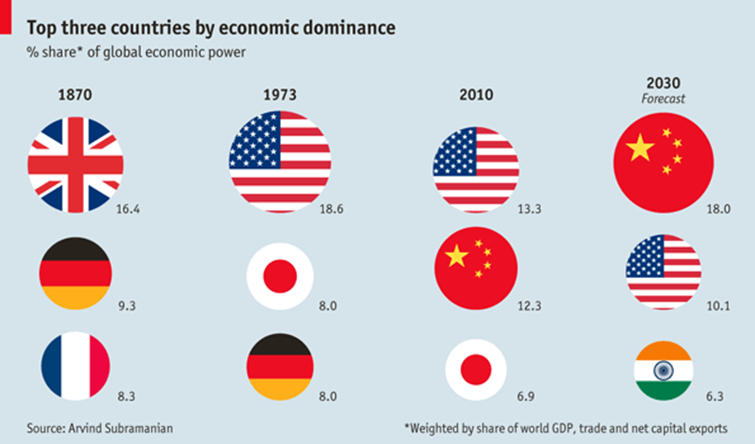
Based on its proportion of global GDP, trade, and exports, China is expected to replace the United States as the world's major economic power by 2030.
The need for connection — and hence transportation infrastructure – for economic growth and development is something China knows very well. The One Belt One Road project, which has two pillars: the Silk Road Economic Belt and the 21st Century Maritime Silk Road, is the country's main development framework. This development project encompasses an area with a GDP of 55 percent, a population of 70 percent, and 75 percent of the world's known energy sources. According to Reuters, "the investments will include nearly 300 projects stretching from Singapore to Turkmenistan."
As China’s growing global role and increasingly hard-line policies at home and abroad gain attention, the United States and other Western governments are also taking notice of China’s expanding influence in developing countries. The implications of China’s growing investments linked to the Belt and Road Initiative (BRI), its ambitious global infrastructure and connectivity program, are increasingly debated. So, too, are the nature of the Chinese Communist Party (CCP) efforts to popularize its authoritarian model and undermine developing democracies around the world, whether intentionally or indirectly. In November, Vice President Pence noted that the administration, through its Indo-Pacific strategy, intends to bolster the rule of law and human rights in regional countries facing growing influence from China.
Beijing aims to use overseas investment and the establishment of markets for Chinese goods and commodities to alleviate China's increasing economic woes and slowing growth. The soundness of China's economy determines the Party's legitimacy. China's engagement with the developing world has traditionally been motivated by the need for resources to fuel its rising economy, but the Chinese economy is now in trouble. As a result, Chinese policymakers are aiming to increase international investment and trade, which have been increasing for years but have been rebranded as part of the BRI. The development of Chinese enterprises' worldwide presence is facilitated by BRI initiatives, many of which are executed by province governments seeking to profit. These initiatives are seen as vital to maintaining development and employment as China transitions from a manufacturing-based economy to one based on services and consumption, including potential changes that will result in layoffs.
However, the US has been incredibly focused on “policing the world” as the Pentagon now has over 750 sites in over 80 nations and territories, forming a pointillist empire that stretches across the world. Mike Pence informed West Point's graduating class this spring that conflict would be a "virtual certainty" for them. (He then gave a long list of prospective destinations, ranging from the Americas to the Korean Peninsula.) Even when there are no troops on the ground, US drones fly overhead, spying on individuals and shooting missiles at them. According to the Bureau of Investigative Journalism, airstrikes have killed more individuals in the United States in the last five years than police shootings. Such arrogance has elicited a lot of sneers in the past, but never more so than now. The concept that the United States stands for anything other than naked self-interest is one of the political dogmas that Donald Trump has shattered in his four years as President. He ridiculed international accords, adored tyrants, and mocked the idea that the US could act as an unbiased arbiter in foreign affairs. He did not appear to be as focused on global leadership as his predecessors, and this was not due to a lack of respect for international rules. "We're America, bitches," one senior Administration official said simply when asked to characterize the Trump Doctrine.
But one can't help but question if that figure is largely a reaction to the unique disasters of those two futile, never-ending wars. Perhaps the present aversion to military adventurism is only the latest example of the American public's periodic inclination to weary of unsuccessful wars—think Vietnam—only to rally behind the flag again when a shiny new product rolls off the assembly line—think the first Gulf War. Even if it reflects a broader anti-militarist sentiment, it is far from evident that it signals a shift toward a more internationalist foreign policy. It's also possible that it represents a "selfish" rejection of the world—after all, according to the same study, 75% of Americans believe the "US should prioritize domestic difficulties before global policy issues." Which "domestic matters" are emphasized and in what ways determines how you understand it. However, it's difficult to see how that notion of restraint would assist us much with really global issues like climate change.
The US-centred system was established at the conclusion of WWII when the US economy was greater than the economies of the next four largest countries combined. In some ways, it is now smaller than China's. The dilemma of US superiority has been building for decades, but it has now reached ahead. If the US maintains its increasingly untenable stance, it will become "a military, overextended empire in a chronic state of anxiety," posing a constant threat to the peace it purports to safeguard.


Comments